
Jesters, Jinn, & DMT Entities: Encounters with Archetypes and the Unseen
A cultural, archetypal, and metaphysical exploration of the ineffable and its impact on mental health.


Beware of unearned wisdom.
— C. Jung, Letter to V.W.
The danger is that people become the victims of these psychic forces, falling under their spell and mistaking them for personal decisions or individual convictions.
— C. Jung, Man & His Symbols
Possession by an archetype turns a man into a mere automaton. He is no longer a conscious individual but a personification of the unconscious.
— C. Jung, Archetypes & the Collective Unconscious
If you have a sound intellect, a lofty aspiration, a firm character, and a strong heart, and you are well-versed in knowledge, then go ahead. Otherwise, beware of summoning them, for you will harm yourself. For they are great kings. And beware of looking at them, for it will bare all in your heart.
— Al-Buni, Shams Al-Ma’arif
Imagination is like the image that a human sees in the mirror.
— Ibn Arabi, Futuhat Al-Makkiyah
The sincere heart
serves as a mirror;
Mysteries are directly observed
through it.
— Hakim Sana’i, Diwan
DISCLAIMER:
This article is for informational and educational purposes only. It reflects personal insights and is not intended as medical, psychological, or legal advice. The use of psychedelics carries risks and may not be suitable for everyone. If you choose to explore these substances or related practices, please do so responsibly, with proper support, and follow the laws of your region.
I felt a sense of urgency to write this journal article, and it may not be the only time for three key reasons. First, I have often been approached with questions about DMT entities, jinn, and black magic. Second, while valuable, observing and partaking in discussions on these subjects in my immediate circles and across the collective—particularly on social media—often leaves much to be desired.
Third, I aim to offer an angle on alternative therapeutic modalities rooted in Islamic cosmology and cross-cultural spiritualities—a perspective much needed in mental health. (If you are interested in this part of the conversation, read my article Healing the Soul (1): Islamic Psychology and Transpersonal Therapy for Mental Wellness.)
A great deal of mystery and confusion continue to shroud these topics.
DMT, or dimethyltryptamine, is a naturally occurring psychoactive compound in certain plants and animals. It is the primary active ingredient in traditional brews like the Amazonian plant medicine ayahuasca, but surprisingly, it is not found in psilocybin (or what is known as magic mushrooms).
In ayahuasca, it is more commonly associated with vivid, otherworldly, cosmic-type visions and autonomous entities. While psilocybin in mushrooms typically fosters introspective and emotionally grounded experiences—though at higher doses, mushrooms can also evoke encounters with entities.
Despite its elusive nature, consciousness can be explored by anyone through meditation, breathwork, fasting, psychedelics, and so much more. Some of these tools are parts of sacred rituals in some contexts; in others, they are parts of interesting fads!
A pressing question arises: "Just because these consciousness tools are accessible to anyone, are they truly for everyone?"
This question cuts to the core of the ethical, spiritual, and psychological complexities surrounding psychedelics and anything that may alter our states of consciousness. For some people, breathing exercises or even fasting can be very intense.
This caution upholds the profound potential for healing, sense-making, and transformation these tools offer. Readiness, intention, and discernment remain crucial because of those reasons.
Since 2019, I have been co-facilitating psychedelic integration groups, witnessing firsthand a need for proper harm reduction models that include frameworks that not only prepare but also assist individuals in making meaning of insights and complex revelations received from what may be defined as extraordinary states of consciousness.
An adept traveller of any spiritual path who becomes a healer, particularly one that includes shamanic aspects, usually learns and trains for years under an authentic teacher who belongs to a lineage ensuring necessary safety, vigilance, and humility.
Only some become healers, while most people seek liberation from their suffering. Choose your path wisely, find community, and avoid ego idolatry or spiritual materialism.
There is a fine line between evolving your soul and navel-gazing. One opens you to the expansiveness of love, both human and Divine, and the other is contractive and enslaves you to the machine or, worse, other people’s opinions!
Your soul is not a self-development project!
Introduction
Humanity has always sought to understand the unseen. In this pursuit, extremes often emerge: fear, outright dismissal, or fascination that borders on deification. Religious traditions frequently warn against engaging with entities or delving into the occult, portraying these forces as deceptive or dangerous.
Conversely, New Age movements often romanticize such encounters, treating them as experiences worthy of unquestioned reverence—an approach that can inadvertently lead to ego inflation and manipulation.
Scientific explanations, on the other hand, reduce these phenomena into mere hallucinations or psychological projections, which may offer relief to some but provoke debilitating anxiety in others, all while neglecting their potential to foster healing and deeper meaning.
The truth lies in neither extreme(s) but a balanced, nuanced approach. After all, it is wise to remain rooted in the world of the seen and ground oneself in the tangible—unless you are one of those individuals for whom the path has chosen you.
Despite my best efforts to avoid or minimize this aspect of human existence in my personal life, I am writing an article on a topic I never thought I would: jinn!
As such, I explore the enigmatic worlds of DMT entities and jinn, drawing on insights from psychology, magic, and mysticism to offer a holistic understanding of these phenomena.
Many wonder whether encounters with DMT entities, shadowy figures, or unsettling archetypal dreams are projections, interactions with external forces, or something more profound.
These inquiries reflect a broader cultural tension: mainstream perspectives often frame such phenomena as superstition or external threats to be dispelled by some ritual or incense burning.
While energetic shielding is essential, some are even ancient. They can sometimes obscure subtle psychological vulnerabilities that require psychotherapy. This imbalance often leaves individuals disempowered and trapped in fear or avoidance.
My fascination with the unseen stems from a childhood filled with vivid dreams that reached beyond the personal into the collective unconsciousness. At one point, seeing apocalyptic-type dreams was part of my regular night routine!
As a young adult in my late teens, however, I managed to shut down parts of my inner self to reduce the intensity of my dreams and otherworldly encounters, dismissing them as the mere whimsy of a child with both a wild imagination and severe trauma.
It worked until I experienced my first of many ego-dissolutive experiences in the Amazon. With years of research, education, and seeking exploratory healing, I aim to offer a thoughtful and accessible lens for understanding the interplay between the light (seen) and the shadow (unseen).
My reflections are an invitation to engage with the mysteries. Language cannot fully capture the liminal worlds, subtle planes, and the numinous. As you read on, I hope you get a taste of the deeper truths these realms may offer.
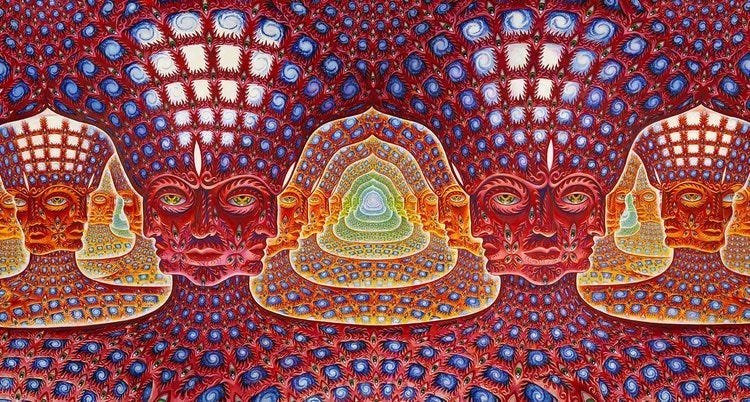
Machine ElvesAlex Grey’s “Machine Elves” piece depicts inter-dimensional beings often encountered in DMT space. They seemingly represent manifestations of cosmic consciousness that challenge our concept of reality by creating time warps.
Jinn & DMT Entities
In Islamic cosmology, jinn are part of the natural order of creation and are described as beings created from smokeless (mārijin 15:27) or scorching (samūm 55:15) fire. They inhabit a hidden dimension paralleling the human world. The root word of (جن) jinn is (ج ن ن) j-n-n, which means ‘to hide’ or ‘to conceal,’ emphasizing their invisible nature. It could also imply their capacity to veil or warp reality.
Jinn are described as free-willed beings, much like humans, with roles depending on their state of being. They can be malefic or mischievous, contributing to black magic and binding rituals, but they are also known to be benevolent and spiritually advanced. They often assist in breaking the effects of black magic and aiding in healing rituals.
Exoteric-leaning, more orthodox Islamic scholars unequivocally warn against engaging with jinn.
Sufi masters, such as Ibn Arabi, have written about them, acknowledging their existence and interactions with humans. In his Meccan Revelations, Ibn Arabi situates their rank in the hierarchy of creation as between humans and angels.
However, their nature of fire and air makes them proud, disobedient and intellectually unstable in the face of the strength, humility and intelligence of the human being’s nature, which consists of water and earth. Perhaps the question of whether the genie is superior or inferior to man is less relevant than the principle that all created beings represent a form of manifestation which must be internalized by man on his path to spiritual realization.
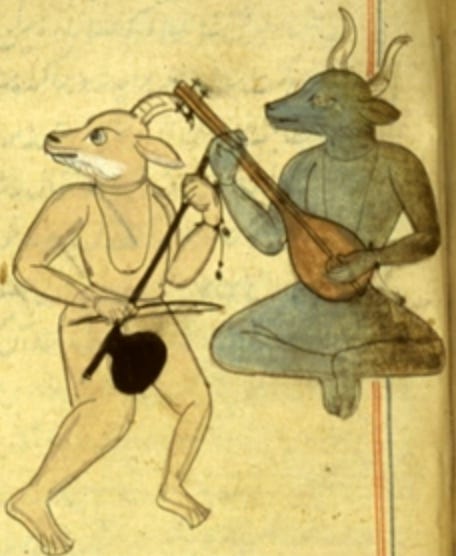
The Book of JinnThe illustration depicts humanoid-type animal-like spirits, somewhat echoing certain DMT entities.
The Book of Jinn was initially published in 1282 by polymath scholar Al-Qazwini, a physician, geographer, and mystic.
DMT users often report encounters with entities—jesters, machine elves, humanoids, insectoids, or tricksters—that mirror the unpredictability and liminality of jinn. Both provoke profound emotional responses, challenge perception and sometimes offer insights or caution.
While jinn are deeply tied to a cosmological framework, DMT entities are often interpreted as projections of the unconscious or beings from inter-dimensional realms.
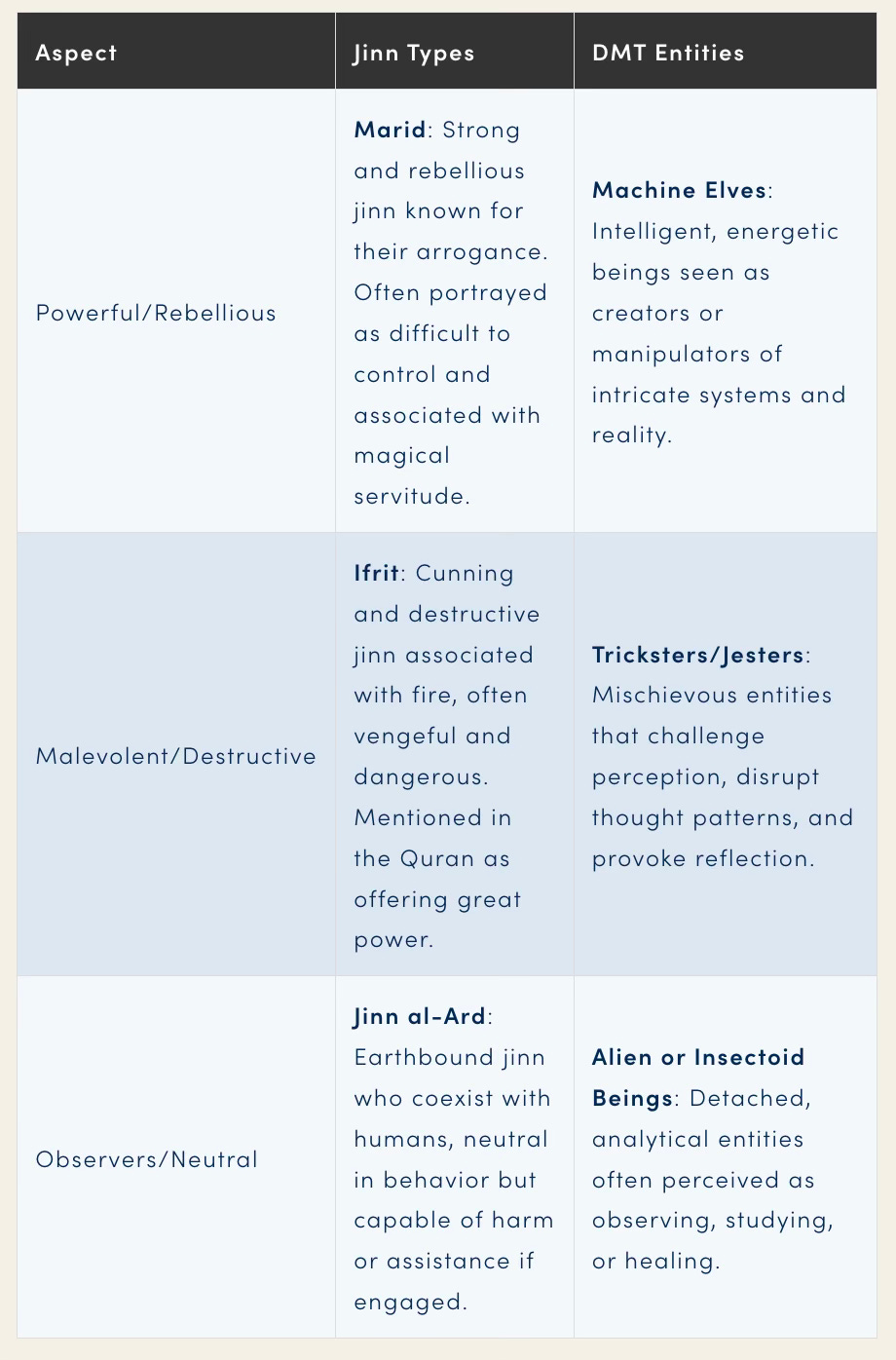
This table compares jinn and DMT entities, highlighting shared traits that reflect universal archetypal characteristics such as rebellion, malevolence, and neutrality. While thought-provoking, the table simplifies complex traditions, emphasizing thematic overlaps rather than equivalence.
Nonetheless, this sparks compelling questions about whether entity encounters reflect archetypal patterns, cultural conditioning, a shared metaphysical reality, or all of the above!
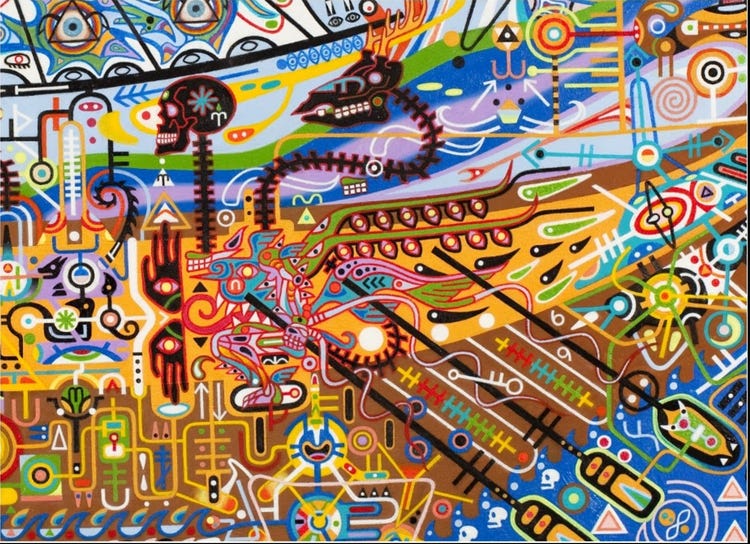
Roadmaps to RealityShawn Thornton, an artist influenced by a tumour in his pineal gland that evoked vivid, mystical visions that resonate with psychedelic imagery, wildly as the pineal gland is speculated to produce DMT.
Amazonian Encounters
My experience at an ayahuasca retreat in the Amazon in the summer of 2018 makes it hard to dismiss specific visions as mere projections. The machine elves’ maze I witnessed brought me down to my knees. The nature of reality collapsed, or realities! The only way out was utter surrender of any rationality. Only then was I given respite from the chaos, ushered into clarity, unity consciousness, and ego dissolution.
After that, dear reader, I must pause as language falters in capturing the depth of what I felt and sensed. Some experiences defy articulation. Of course, I also have to keep the juicier parts for the book I am currently writing!
Nonetheless, the sense of "I" -ness within my awareness was overshadowed by profound awe and reverential majesty. As reflected in the table below, both mystics and psychologists have endeavoured to articulate the qualities of what we perceive as mystical or religious experiences.
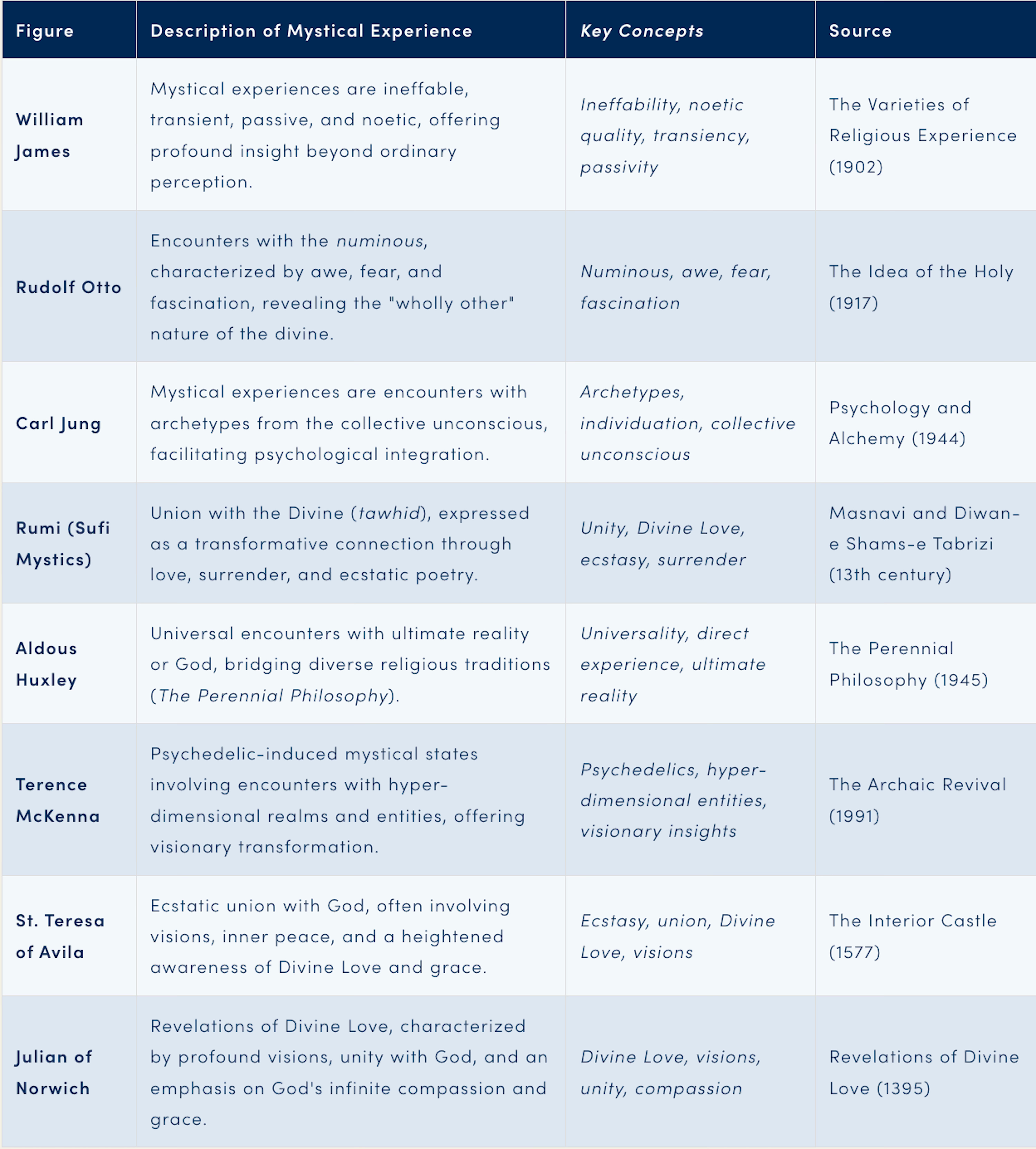
Despite my ego’s rumbling, and after much toil, I could access an inner state of silence—a profound stillness accompanied by the feeling that everything would be all right, reminding me of Julian of Norwich’s ecstatic utterances and visions that arose due to severe physical illness in Revelations of Divine Love, as she grappled,
...with the concept of sin and suffering; Jesus appeared to her and said, “Sin is behovely, but all shall be well, and all shall be well, and all manner of thing shall be well.
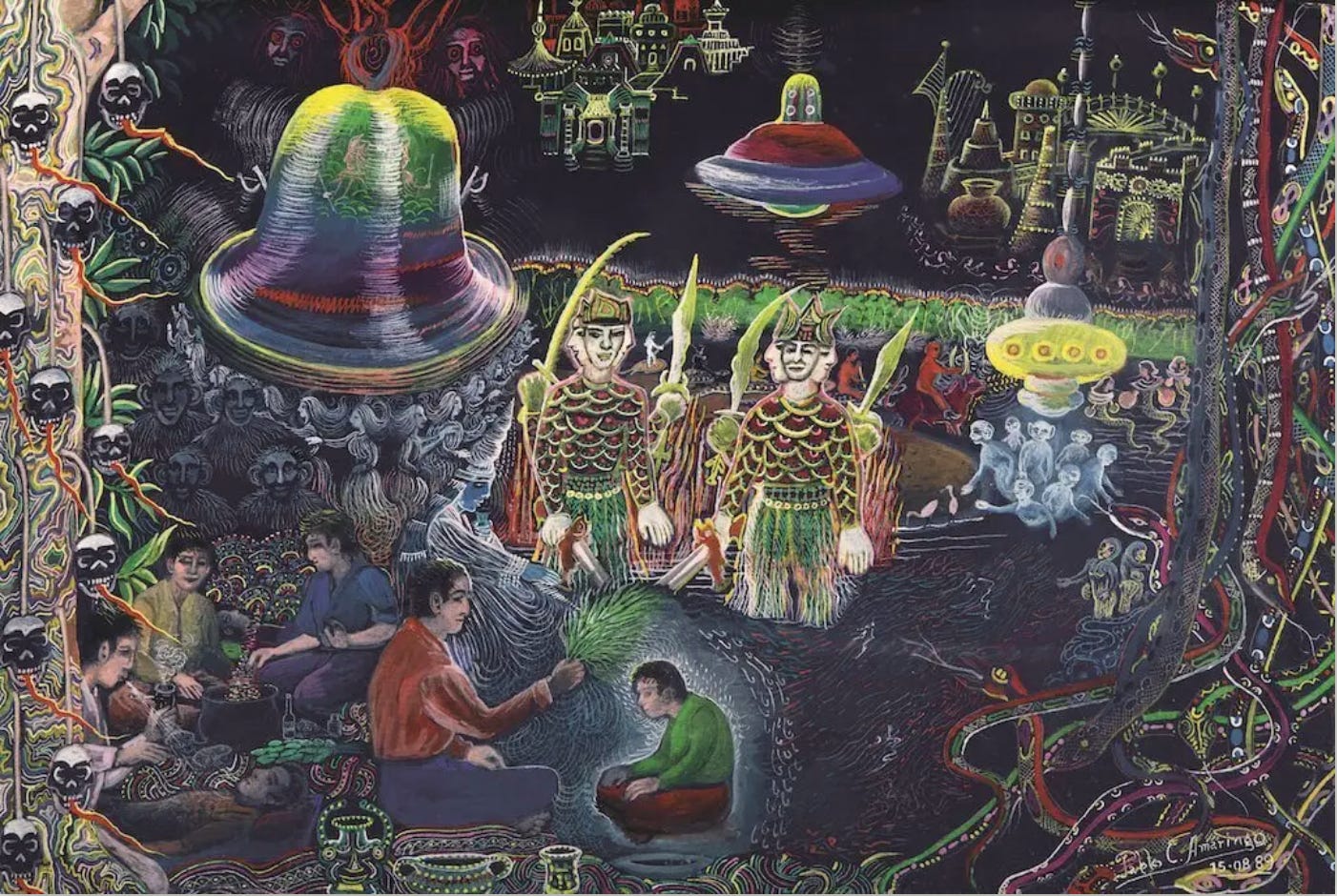
Campana Ayahuascana The Peruvian artist Pablo Amaringo, who also trained as an ayahuasquero, saw the flying saucers in his painting as spiritual entities visiting from other dimensions rather than UFOs despite their vast resemblance. This emphasizes the importance of considering the cultural lens.
When I felt that “all shall be well,” I began comprehending the essence of innate, basic goodness: a state of fitrah, the primordial, Buddha-like nature inherent in us. Many traditions allude to this universal truth, including certain denominations within Christianity(*).
What happens when extreme pain gets in the way of our life? Of love? Can trauma warp our inherent nature?
Panic Attacks
One of the visions that continue to haunt me involved a figure—Pan or the devil(ish), i.e. jinn, or perhaps something else entirely—emerging from the shadows, goat-hooved and grinning. Its wild, chaotic energy felt familiar and deeply unsettling, as if it held a mirror to something I didn’t want to see. It pointed toward things I held dearly at the time.
"Is this what you cling to?" it seemed to ask, though its mouth never moved. Its laughter wasn’t cruel but sharp, cutting through my defences and showing me how scared I was.
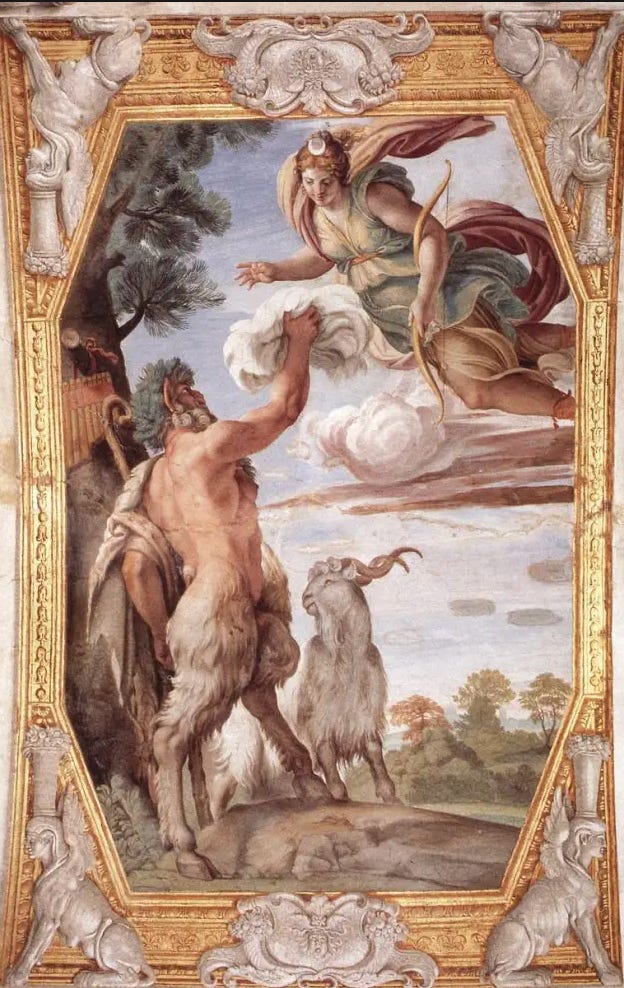
Pan, an archetypal figure from the collective unconscious, specifically Greek mythology, embodies primal chaos, creativity, and permeable boundaries.
It wasn’t lost on me that I, too, was a goat. Born in the Capricorn season, represented by the mythical sea goat, always striving for structure, discipline, and a steady climb upward.
Little did I know that one day, in the jungle, I would have to reckon with suppressed, untamed, and chaotic parts of myself. Pan challenged primal fears that have lingered since childhood by evoking the very panic states I tried hard to escape by dwelling in depression for years.
My psyche swung violently between the mocking figure and the writhing snake that I had noticed since the beginning of the journey. The serpent, also known as the spirit of the plant medicine ayahuasca, was the remover and cleanser, helping me shed layers of what no longer served me.
“You think you got this figured out, child?”
When I returned home to the snow of Toronto from the sticky humidity of the Amazon, a friend lent me a book titled “Sacred Knowledge: Psychedelics and Religious Experiences” by William Richards. Finally, I could put some of what I experienced in words that befit my Western-trained mind. A light bulb illumined somewhere in my brain when I came across the lines below,
A fascinating discovery in speaking with mystics from different world religions is how secure they appear in their certainty of the reality of a sacred dimension of consciousness and how little they care about what words one may choose to describe it. If you like the word “God,” that’s fine; if you prefer “Yahweh,” “Jehovah,” “The Christ Consciousness,” “Allah,” “Brahman,” “The Great Spirit,” or simply “The Higher Power,” that’s also OK. If you would rather verbalize the ultimate reality as “The Void,” “Nothingness,” “Nondual Awareness,” “The Pure Land,” or “Celestial Buddha Fields,” even that is acceptable.
The passage poignantly encapsulates what it truly means to be a mystic, a person comfortable with paradoxes.
What is an authentic mystical experience?
Consider the "Good Friday Experiment" conducted in 1962 by Walter Pahnke, the same researcher who developed the questionnaire to measure mystical experiences. In this study, seminary students were given psilocybin during a Good Friday church service to investigate whether psychedelics could induce authentic mystical states.

The results were remarkable: Many participants reported profound spiritual moments that mirrored classical accounts of mysticism—feelings of unity, ineffable joy, and a transcendence of time and space. Decades later, follow-up studies revealed that these participants continued to view the experience as one of the most meaningful events of their lives.
Scientists who rely solely on the quantifiable often dismiss mystical experiences as chemical reactions in the brain. Traditional skeptics may write them off as demonic or egoic. Transpersonal psychologists measure them!
Does the label matter? Yes and no. The essence of such experiences often surpasses the categories we impose on them. They only become dangerous when they cause genuine harm to the soul, fracturing rather than uniting the person.
For example, someone who experiences an intense vision of unity might misinterpret it as a mandate to isolate themselves from others, believing they have transcended the mundane world entirely. This disconnection can lead to alienation, delusions of grandeur, or even psychosis, severing the person from both themselves and their community.
It is no wonder that the master-disciple relationship has been emphasized since time immemorial. It is a necessary container for spiritual seekers who experience intense visionary states.
Archetypal Psychology and Trauma
Trauma is more than a psychological wound; it is a disruption in the soul's natural flow. Archetypal psychology, pioneered by James Hillman, offers a profound trauma framework by shifting focus from the personal to the universal. It situates human pain within the larger patterns of myth and image that shape existence.
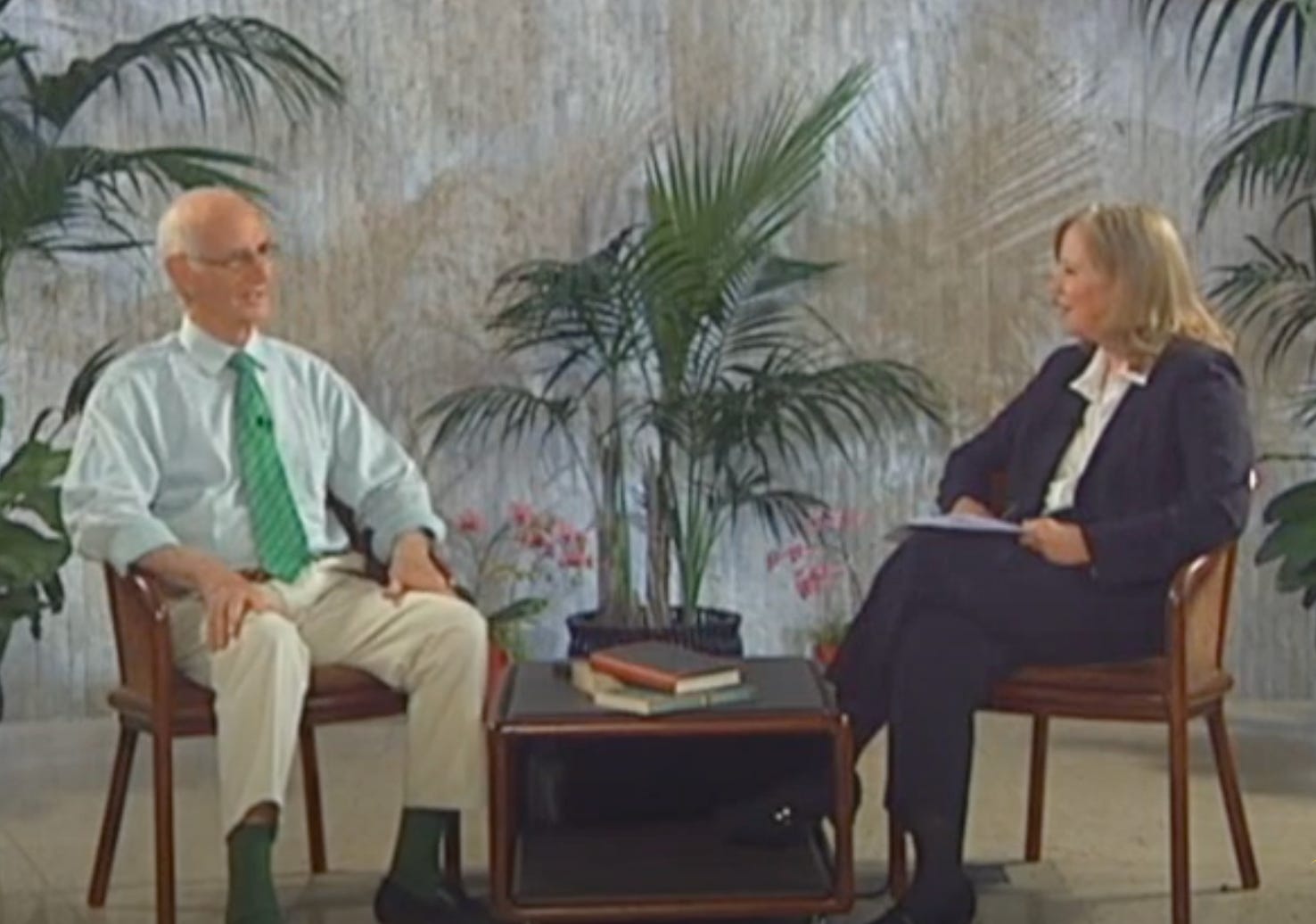
James Hillman || Archetypal Psychotherapy & the Soulless Society (2010)
Archetypes—universal patterns and energies embedded in the collective unconscious—are at the heart of archetypal psychology. Trauma activates these archetypes, pulling us into a realm where everyday logic falters, and deeper, symbolic truths emerge.
For instance, Carl Jung's archetype of the Shadow Self embodies the rejected, feared, and unseen aspects of ourselves. This confrontation can feel chaotic, even evil, as if forces beyond our control are at work. You can read more about shadow work in another journal, Shadow Work: When Your Unlived Life Looms.
The Jester and the Trickster archetypes are not entirely separate but are overlapping expressions of energy that challenge norms and disrupt structures. The Jester leans toward humour, playfulness, and a lighthearted approach to subversion.
The Trickster is more chaotic, boundary-breaking, and destabilizing, frequently acting without regard for consequences. Both are agents of chaos and transformation that push individuals or systems to confront deeper truths.
The trickster and Satan are interconnected as figures that challenge norms and provoke transformation, embodying the shadow aspects of the psyche.
Dr. Robert Moore's lecture, "The Trickster Archetype: Potential and Pathology, explores this relationship. " In it, he discusses how the trickster's disruptive qualities mirror Satan's adversarial role in psychological development.

Dr. Robert Moore || The Trickster Archetype: Potential and Pathology (1989)
Trauma is not merely a rupture but a sacred dialogue with the unconscious. Within the depths of our suffering lies the healing potential. Entire societies carry the weight of historical and systemic trauma, which often amplifies archetypal forces—just turn on your TV or look at your phone screen!
Magic and Alchemy
The discussion on jinn and DMT entities would be incomplete without discussing their third accomplice: black magic. A topic that requires a separate journal entry.
I am still determining, however, if I want to engage with this topic again!
Exoteric magic refers to outward, accessible practices grounded in cultural traditions, visible rituals, and tools for tangible outcomes like protection or healing. In contrast, esoteric magic delves into hidden, mystical practices requiring initiation and more profound knowledge, focusing on spiritual realization and cosmic alignment.
While exoteric magic can be community-oriented and symbolic, esoteric magic is more inward and metaphysical. Despite these distinctions, they often overlap.

Alchemy, considered primarily esoteric, often involves deeply symbolic, spiritual, and philosophical practices aimed at inner transformation.
Its metaphor of turning lead into gold represents the transmutation of the soul toward Divine alignment.
Exoteric alchemy exists in its practical application as early chemistry, focusing on material experimentation.
Historically, fear around the impact of such practices fuelled the witch trials, where individuals—often women—were persecuted. This period of human history may reflect society's mistrust of the unseen, even though the persecutions were rarely just about magic; they were often entangled with broader issues, including politics, social control, and the subjugation of marginalized communities.
No matter which way you look at it, psycho-spiritual manipulation of any soul is not only ethically problematic but fundamentally unacceptable, if not demonic.
Narcissistic abuse and casting a spell may feel strikingly similar—after all, verbal abuse relies on words, and to wield words, one must first "spell" them correctly.
This dynamic mirrors themes in the triad of dark psychology, particularly psychopathy, where manipulation and control dominate interactions. Similarly, lower forms of magic can exploit vulnerabilities for personal gain. One is rooted in psychological constructs, while exploitative magic operates within symbolic and spiritual frameworks.
Again, turn on your T.V. or look at your phone screen! (*)
When approached with discipline and integrity, this knowledge is framed as the path of the sage or the Gnostic—seeking a direct, transformative understanding of the Divine rather than mere manipulation of forces.
Misusing Sacred Knowledge
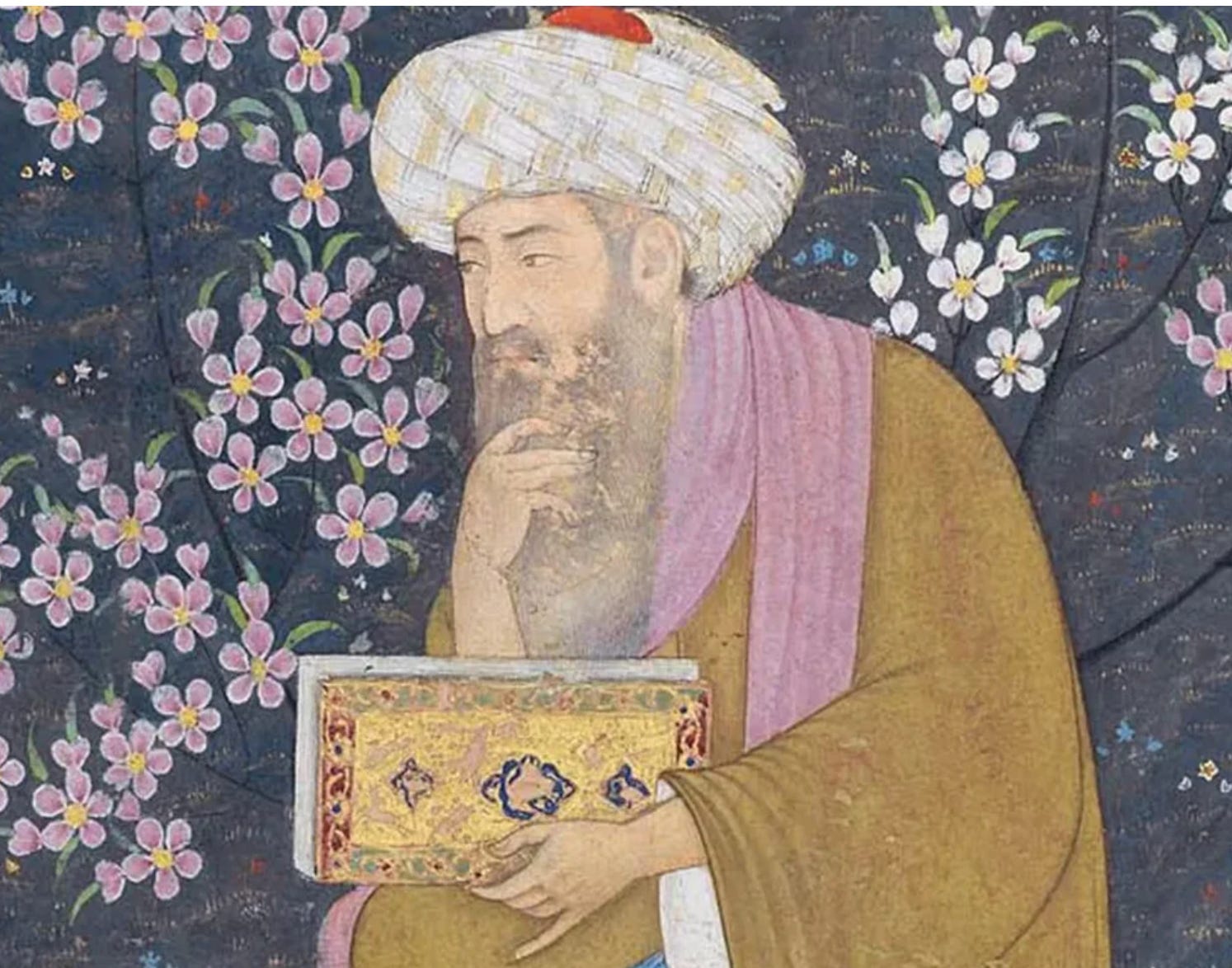
Ahmad al-Buni, quoted at the beginning of this article, lived during the 12th and 13th centuries, though exact dates are unclear. He is generally believed to have died around 1225 CE. His most famous work, Shams al-Ma'arif al-Kubra (The Great Sun of Knowledge), is a foundational text in Arabic esotericism.
He wrote extensively about the powerful interplay between the Divine Names, celestial forces, and jinn. Al-Buni emphasized the potential for his book to heal or harm, depending on the practitioner’s inner state of being.
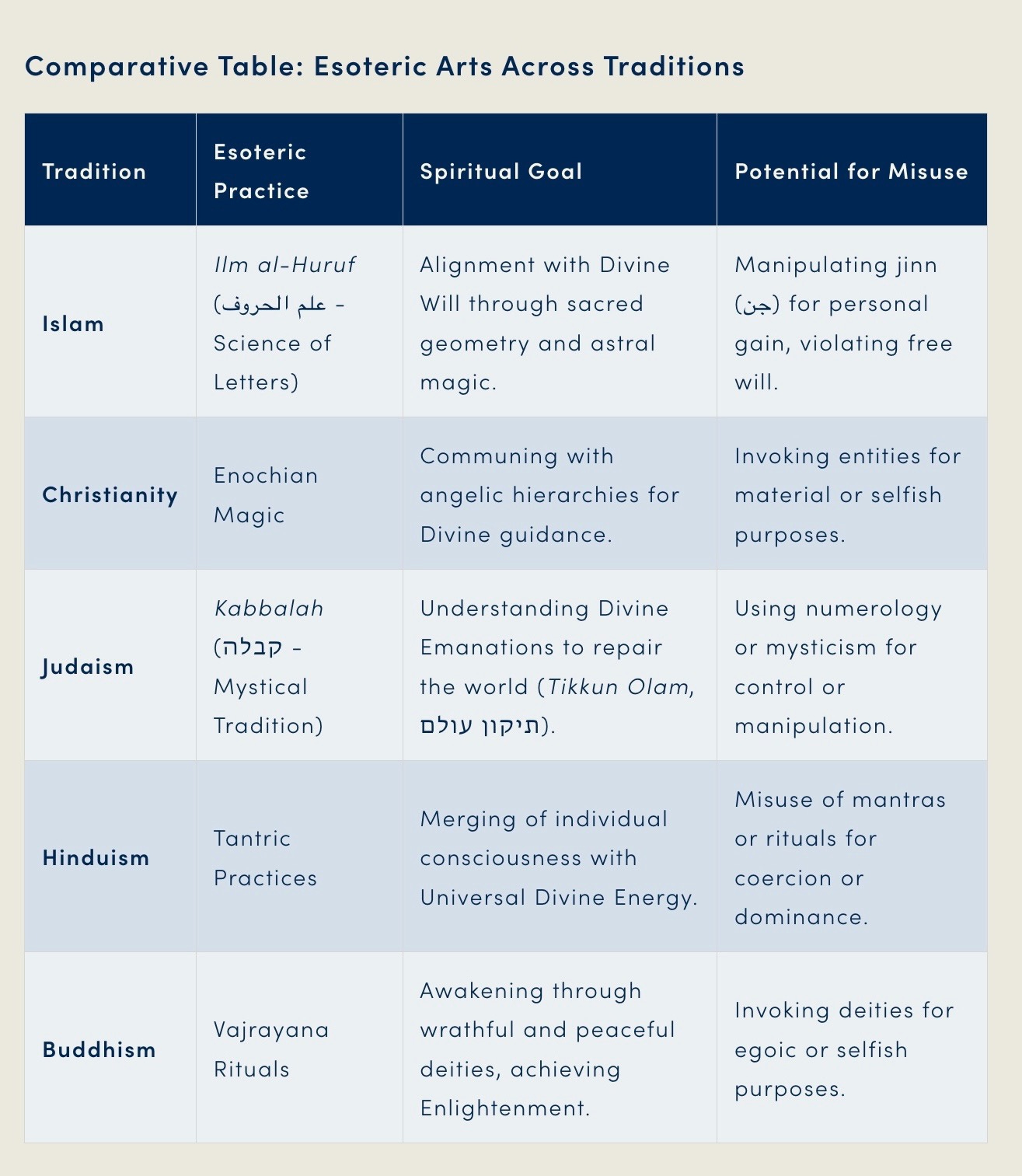
The comparative table above briefly summarizes esoteric traditions across cultures, epochs, and examples of potential misuse.
Unfortunately, Al-Buni’s work is misunderstood by some Muslim internet evangelists, often described as a book of black magic spells, and some refer to the author as an apostate, not even a heretic. The book does contain specific talismanic formulas and amulets that are best left alone, but it is not for the non-initiate.
Still, no practice in the book goes without invoking some Divine name known to any average Muslim. One of the names Al-Buni calls upon a lot is,
Oh, Eternal One! Oh, Infinite. Oh, Allah!
Beseeching the Creator of creation while recommending intensive spiritual preparation, fasting, and moral discipline. He even uses Quranic verses after ritual cleansing and incense burning.
Regardless, Shams al-Ma’arif is not a bedtime reading. Some of the information the author disseminates is very potent and, under the wrong hands, can cause proper damage. I exaggerate, not!
It’s no different from someone recklessly diving into a psychedelic experience without preparation or respect, only to emerge scarred rather than healed.
Unsurprisingly, his work faced censorship throughout Islamic history, much like other figures associated with the Arabic Hermetic tradition, such as Jabir ibn Hayyan (c. 721–815) and Al-Kindi (c. 801–873).
Jabir ibn Hayyan
Often called the "Father of Chemistry," Jabir focused on spiritual and material alchemy, emphasizing the transmutation of elements and the purification of the soul.
His work reflects the Hermetic principles, such as the correspondence between the macrocosm (universe) and the microcosm (individual).
Many debates were led about the authenticity and legitimacy of Jabir’s work in Islamic orthodox circles.
Al-Kindi
A philosopher and scientist, Al-Kindi bridged Greek Hermetic texts and Islamic intellectual traditions.
His work on celestial influences also reflects Hermetic themes, particularly the idea that the heavens shape earthly affairs (as above, so below).
Al-Kindi faced political opposition and intellectual rivalry. Historical accounts suggest that during the rule of the Abbasid caliph Al-Mutawakkil, Al-Kindi’s library was confiscated, and he was briefly marginalized due to his association with philosophical ideas that were viewed as contentious.
I do not believe in censorship, but some topics demand gravitas. Ideas that carry profound complexity require careful handling to prevent harm or misunderstanding. Not to gate-keep but to honour the responsibility of the power of free thought.
Are You Over Forty Years Old?
Traditionally, Kabbalah was reserved for those over forty, reflecting the belief that spiritual maturity, life experience, and discipline were essential prerequisites.
Without discernment, power can lead to imbalance—a recurring caution across esoteric traditions.
These teachings align with Kabbalah’s insistence on humility and purity of intention. Accessing the unseen world should be done with reverence and readiness, as misuse could lead to spiritual corruption.
Similarly, in Buddhist Vajrayana, there is a warning against unprepared engagement with advanced practices.
The Demiurge & Gnosticism
Ignorance of Divine Reality:
In Gnosticism (a Christian tradition that focuses on inner-knowing, gnosis, that leads to enlightenment), the Demiurge, an archetypal representation of evil, mistakenly believes itself to be the supreme being, demonstrating arrogance and spiritual blindness.
Creation Without Wisdom:
The material world, crafted by the Demiurge, is seen as flawed and incomplete—a reflection of the Demiurge’s ignorance and distortion rather than enlightenment.
Trapping the Divine Spark:
The Demiurge imprisons the divine spark within human souls in the material world, perpetuating suffering. Similarly, misuse of sacred knowledge can entangle individuals in ego-driven pursuits, preventing them from realizing true liberation.

Dark Shamanism
In Psychology and Religion at the Millennium and Beyond, a collection of essays edited by J. Marvin Spiegelman, the concept of dark shamanism or assault sorcery is discussed through the story of Mary, who was raised Jewish, a California-based Jungian analyst whose journey reveals the psychological perils of engaging with ego-driven healers.
The analyst sought guidance from a practitioner who claimed to offer profound spiritual insight. Over time, however, Mary realized the arrogance underlying her personal choices.
According to Mary’s narration of her story, her abandonment of belief in God had left her vulnerable. She relied instead on a healer who lacked humility and exploited her trust.
Rather than providing true insight and medicine, the so-called shamanic practitioner vampirically tried to snuff out Mary’s life force. She recognized almost too late that she was drained emotionally and spiritually and that for most of her life, she was dealing with a sorcerer.
Is it not the purpose of a dark incantation to make someone fall under a spell, under the bind of illusion—an awareness that can easily remain outside the radar of the modern human psyche?
The news hit her hard when she discovered that other shamans did not want to work with this person she trusted. For years, Mary was kept sick and surrounded by inexplicable adverse events. She could not understand why she had not seen that before.
All was revealed, incidentally, by another Jewish clairvoyant, Mary adds, who helped her come back from the brink of death!
For the modern human, living in a world dominated by materialism and fragmented attention, this awareness of manipulative forces—psychological, spiritual, or archetypal—is often dulled.
The spell works because it plays on archetypal energies, those primal forces that dwell in the collective unconscious—a realm many may not know but is certainly felt. It manipulates fear, desire, and shadow aspects that remain unresolved or unacknowledged.
Among peoples of the Northwest Amazon, a person is not born with the powers of a sorcerer; rather, a person acquires knowledge about poisons and poisoning informally from other, more experienced sorcerers. Any person can use sorcery to take vengeance against an enemy. STILL, the true “poison-keeper,” as they are called, is one who has committed sorcery repeatedly until his or her only thoughts are to kill.
The main takeaway is that sorcerers not only summon evil forces but actively strip away their humanity to become an enemy spirit that is constantly adversarial.
To overcome anything that lurks in the dark, one must cultivate embodied awareness—not just intellectual understanding that can discern illusion from reality.
Without awareness, the psyche remains vulnerable to the pull of a labyrinth of its own making.
Context matters; practices one person deems dark or black may have been vital in a different epoch or are still needed in a different place.
Like war magic: the battle trance of ecstatic warriors!
The Dangers of Human Ego
A well-known Sufi teacher and master, Habib Umar Bin Hafiz, who is from a traditional lineage from the valley of Hadramawt, Yemen, once said in a public lecture, “The ego is worse than 70,000 demons.”
While seemingly hyperbolic, it highlights the dangers of an unchecked ego, which tends to be insatiable in its hunger and delusional in its attempt to control.
I said, "Show me the ladder, that I may climb up to heaven."He said, "Your head is the ladder. bring your head down under your feet.”―Rumi
Pop psychology tends to focus on the ego in its inflated state, namely narcissism, but the ego in its deflated status is as problematic, if not more, not that it is race! Any individual thinking small or lowly of themselves can be as hurtful as someone who thinks highly of themselves since both represent relational disconnection.
Jesse Stewart is a Toronto-based writer on ancient esoteric traditions, especially ancient Egypt. Many traditions speak about transcending the ego to experience Unity consciousness, but he reminds us that this is often misread as entirely dissolving the ego. You can check Stewart’s YouTube series on the role of the ego and its diseases.
Yes, moments of ego annihilation can offer profound insight. Still, the real work lies in refining the ego—transforming it from self-serving to aligned with higher values, or what is known as tazkiyah in Sufism.
The essence of inner work is to know who you are in the present moment.
Internal Family Systems Therapy: Parts or Entities?
The Internal Family Systems (IFS) therapy model offers a profound way to explore our inner landscapes. It reveals how our psyche consists of 'parts'—sub-personalities carrying memories, emotions, and burdens. Trauma, however, can fracture this delicate system.
For those who dissociate to survive overwhelming pain, the boundaries between internal and external often blur. Dissociation leaves the psyche porous, opening a gateway for what Robert Falconer, in his book The Others Within Us, refers to as "unattached burdens"—energies or entities that seem to exist outside the self but interact with it in deeply personal ways.
This porosity, born of trauma, creates a unique vulnerability. Survivors may unknowingly become vessels for symbolic, archetypal, or actual forces that challenge the conventional limits of psychology and science.
Falconer integrates principles of compassion and understanding into his approach to working with entities, whether they are understood as metaphysical beings or psychological parts. He emphasizes a non-violent, dialogic method that contrasts with traditional exorcisms, which often rely on fear and confrontation. His perspective advocates fostering healing through engagement and integration rather than perpetuating harm or division.
In his book How God Works: The Science Behind the Benefits of Religion, David DeSteno warns of the consequences of neglecting these realms:
If we refuse to take these spiritual technologies seriously as a source of ideas and inspiration to study, we slow the progress of science itself and limit its potential to benefit humanity.
Conclusion: Once You See, You Cannot Unsee
Throughout history, the idea of unseen forces—described as jinn, spirits, or any unseen entities—has transcended religious, mystical, and cultural boundaries. These phenomena reflect our shared human experience of encountering the ineffable.
While these forces are framed differently across traditions, they converge in their ability to challenge, transform, and deepen our understanding of ourselves and the world around us.

Possession, when a spirit takes control over a human body, remains one of the most common human experiences of the unseen. It serves as a powerful metaphor for these encounters. In the Islamic tradition, possession is often viewed as a test of faith. Exorcism (ruqyah) invokes Quranic verses to expel jinn.
Buddhism focuses on chanting and meditation to expel negative energies. Christianity and Judaism use prayers and rituals, such as the Lord’s Prayer or Psalms, to confront demons. Hinduism uses mantras and fire rituals for purification.
In his magnum opus, Carl Jung interprets possession states as the ego's confrontation with the unconscious. In an archetypal possession, shadow forces take hold of the psyche in The Archetypes and the Collective Unconscious,
Possession, though old-fashioned, has by no means become obsolete; only the name has changed. Formerly, they spoke of evil spirits; now, we call them complexes.
These forces—whether shadow aspects of the self, repressed desires, or archetypal energies—can "possess" the ego, disrupting behaviour, thoughts, or emotions until they are integrated into consciousness.
The goal of therapy in these instances is to reclaim balance by making the unconscious conscious, fostering integration and self-awareness.
I highly recommend reading Jung’s warning—to the world—about unwise meddling with archetypal forces (read here).
Finally, I cannot claim a neat conclusion to these themes; the realm of the unseen resists tidy resolutions. I want to explore and branch out into certain branches of this topic, uncommonly possession, black magic, and the healing process from different traditions, including psychology.
Since childhood, my lineage, studies, and personal encounters have shaped this world. Avoiding it was never an option, and perhaps that is why I feel compelled to raise awareness about its complexity—particularly now, during the so-called third wave of the psychedelic renaissance, when discernment is critical.
In Jules Evans's interviews, Jinns, Trips, and Spiritual Psychosis, featuring two Canadians of Yemeni and Muslim heritage, the first story unfolds as a tragic heartbreak. It highlights the grave risks when extraordinary states of consciousness are mismanaged—risks to both sanity and life. Not everyone has the support systems or resources to recover from such an acute manifestation of ego disintegration.
The unseen demands reverence, not fear, and discernment, not recklessness. Authentic engagement with these forces is not about seeking control but balance—walking a middle path, honouring our existence and its mysteries. The soul finds wholeness through this balance and aligns with more extraordinary truths.
“Psychospiritual education, harm reduction, and integration are the least humanity needs as we push the frontiers of our collective consciousness.
Psychedelics are only one tool. There are many others: your breath, depriving your senses, enhancing your senses, your dreams, and prayer or meditation.
Then, as Sufi poet Rumi says, bring your head down to your feet, listen, and surrender to the beat of your heart.”
— ThāL
Thanks for reading! If you have any comments, questions, or corrections, please email info@integrativepractice.ca.
Love this piece. So rich in wisdom across different traditions.
The issue of entities seems vastly underappreciated in the realms of healing (whether traditional or alternative), psychedelics, and spiritual growth/mysticism.
I think it can make people very uncomfortable, particularly the idea of either malevolent or trickster entities. Easier to discard it all as superstition or product of the psyche. As a result we're unprepared for how to navigate these encounters. As you pointed out in the helpful anecdote, this can have serious consequences.
Is there a source you like for "best practices" on how to manage interactions or how to limit them to compassionate/benevolent beings? (setting boundaries, protection, discernment, cleansing, removal if necessary, vs. curious engagement, revelation, receiving healing)?
Christian esotericism is not enochian. Real Christian mystics have nothing to do with 16th century English theosophists. To understand Christian esotericism you need to understand traditional theurgy, the salvific and sacramental elements of the ancient world and how they survived and mostly Orthodoxy.